


All Fertilizer Prices Lower for Third Consecutive Week
For the third consecutive week, average retail prices for all eight major fertilizers were lower than they were a month ago. However, no fertilizer saw a significant price drop, which DTN designates as anything 5% or more.



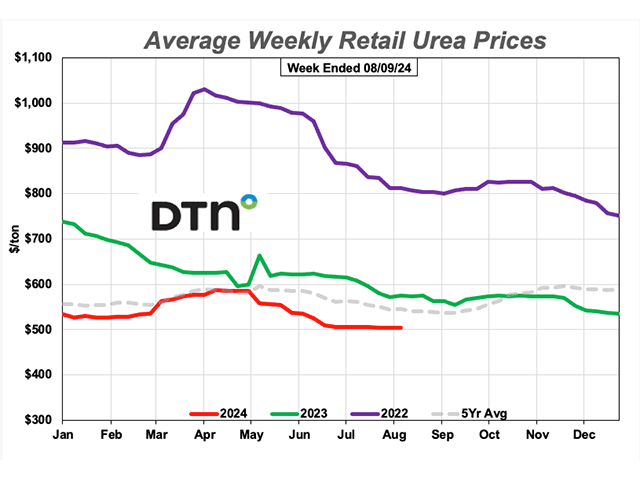
OMAHA (DTN) — Average retail prices for all eight major fertilizers were down again during the first full week of August 2024, according to sellers surveyed by DTN.
This marks the third week in a row that prices for all fertilizers fell just slightly. DTN designates a significant price move as anything 5% or more.
DAP had an average price of $744 per ton, MAP $818/ton, potash $503/ton and urea $504/ton. 10-34-0 had an average price of $640/ton, anhydrous $675/ton, UAN28 $338/ton and UAN32 $376/ton.
On a price per pound of nitrogen basis, the average urea price was at $0.55/lb.N, anhydrous $0.41/lb.N, UAN28 $0.60/lb.N and UAN32 $0.59/lb.N.
Fertilizer Canada is calling on the Canadian federal government and Labor Minister Steven MacKinnon to take immediate action to assist the CN Railway, the Canadian Pacific Kansas City (CPKC) and Teamsters Canada Rail Conference (TCRC) to prevent a rail strike, which already has affected the flow of fertilizer, according to a news release from Fertilizer Canada.
On Monday, CN Railway and CPKC issued embargoes immediately halting fertilizer shipments 10 days ahead of an anticipated labor disruption. The threat of a work stoppage has already begun to impact the movement of fertilizer, according to the news release (https://fertilizercanada.ca/news-events/news/fertilizer-canada-warns-threat-of-rail-labour-disruption-already-impacting-fertilizer-shipments/).
“A work stoppage that prevents the transportation of fertilizer will have potentially disastrous effects on crop yields and food security,” according to the release.
Fertilizer Canada urges the federal government to amend the Canada Labor Code to strengthen the bargaining process. According to polling, three in four Canadians (75%) agree this needs to be done to strengthen the bargaining process for those working in Canada’s supply chains to prevent disruptions and their consequences.
Karen Proud, president and CEO of Fertilizer Canada, said the long-lasting and cascading impacts of labor disruptions are felt before and after the stoppage takes place.
“Farmers around the world rely on Canada’s fertilizer industry to maximize crop yields and the fertilizer industry relies on rail to get our products to market,” Proud said.
Seventy-five percent of all fertilizer produced and used in Canada is moved by rail. There are very limited alternatives to rail to ship fertilizer products.
Canadian, American and international farmers rely on Canadian fertilizer to maximize crop yields. Fertilizer is responsible for half of the world’s current food production, according to the news release.
DTN Cash Basis Analyst Mary Kennedy wrote about the possible rail strike in her Market Matters Blog on Monday of this week (https://www.dtnpf.com/agriculture/web/ag/blogs/market-matters-blog/blog-post/2024/08/12/cirb-decision-prompts-cpkc-railway-3).
All fertilizers but two are lower compared to one year ago. Both MAP and anhydrous are now 7% more expensive looking back to last year.
The remaining six fertilizers are lower. DAP is 2% less expensive, UAN32 is 6% lower, UAN28 is 8% less expensive, 10-34-0 is 10% lower, potash is 11% less expensive and urea is 13% lower in price compared to a year prior.
DTN gathers fertilizer price bids from agriculture retailers each week to compile the DTN Fertilizer Index. DTN first began reporting data in November 2008.
In addition to national averages, MyDTN subscribers can access the full DTN Fertilizer Index, which includes state averages, here: https://www.mydtn.com/agriculture/web/ag/markets/fuels-fertilizers#!/fertilizers.
All retail fertilizer prices were lower last week, although none were down a significant amount, which DTN designates as 5%. You can read about it here: https://www.dtnpf.com/agriculture/web/ag/crops/article/2024/08/06/fertilizer-prices-continue-downward.
| DRY | ||||
| Date Range | DAP | MAP | POTASH | UREA |
| Aug 7-Aug 11 2023 | 758 | 764 | 566 | 576 |
| Sep 4-8 2023 | 738 | 745 | 518 | 563 |
| Oct 2-6 2023 | 705 | 791 | 508 | 573 |
| Oct 30-Nov 3 2023 | 713 | 801 | 508 | 573 |
| Nov 27-Dec 1 2023 | 715 | 820 | 518 | 552 |
| Dec 25-29 2023 | 721 | 812 | 514 | 536 |
| Jan 22-26 2024 | 734 | 809 | 509 | 527 |
| Feb 19-23 2024 | 749 | 812 | 506 | 534 |
| Mar 18-22 2024 | 778 | 823 | 506 | 574 |
| Apr 15-19 2024 | 780 | 830 | 513 | 585 |
| May 13-17 2024 | 789 | 829 | 511 | 556 |
| Jun 10-14 2024 | 779 | 827 | 507 | 525 |
| Jul 8-12 2024 | 758 | 822 | 504 | 507 |
| Aug 5-9 2024 | 744 | 818 | 503 | 504 |
| LIQUID | ||||
| Date Range | 10-34-0 | ANHYD | UAN28 | UAN32 |
| Aug 7-Aug 11 2023 | 714 | 634 | 369 | 400 |
| Sep 4-8 2023 | 611 | 693 | 356 | 390 |
| Oct 2-6 2023 | 609 | 790 | 354 | 414 |
| Oct 30-Nov 3 2023 | 611 | 826 | 358 | 415 |
| Nov 27-Dec 1 2023 | 595 | 847 | 341 | 409 |
| Dec 25-29 2023 | 599 | 792 | 340 | 394 |
| Jan 22-26 2024 | 610 | 770 | 335 | 390 |
| Feb 19-23 2024 | 615 | 764 | 339 | 393 |
| Mar 18-22 2024 | 628 | 793 | 358 | 402 |
| Apr 15-19 2024 | 641 | 794 | 364 | 418 |
| May 13-17 2024 | 642 | 792 | 364 | 418 |
| Jun 10-14 2024 | 642 | 737 | 352 | 400 |
| Jul 8-12 2024 | 642 | 696 | 339 | 378 |
| Aug 5-9 2024 | 640 | 675 | 338 | 376 |
Russ Quinn can be reached at Russ.Quinn@dtn.com
Follow him on social platform X @RussQuinnDTN