


Anhydrous, UAN32 Lead Fertilizer Prices Lower
Only two fertilizers posted price moves of notable size during the second week of January. Anhydrous was 9% lower compared to last month at $776/ton, while UAN32 was 5% lower at $391/ton.



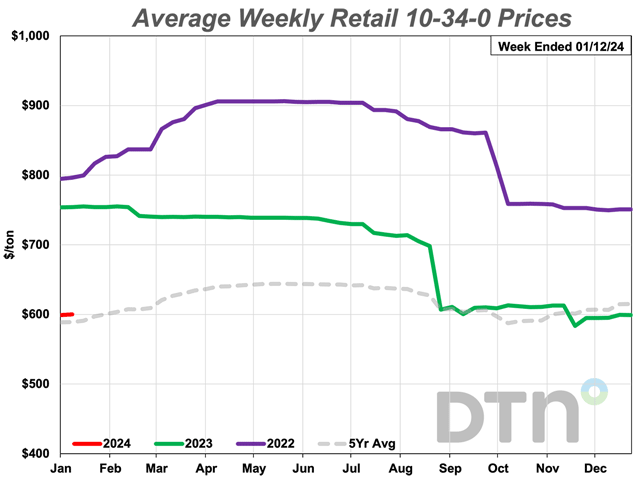
OMAHA (DTN) — Retail fertilizer prices tracked by DTN for the second week of January 2024 continue to show mostly declines compared to last month.
For the third consecutive week, six of the eight major fertilizers were lower in price compared to last month, while the remaining two fertilizers were slightly higher. DTN designates a significant move as anything 5% or more.
Only two fertilizers had notable price changes compared to last month. Anhydrous was down 9% compared to last month at an average price of $776/ton. UAN32 was 5% less expensive at an average price of $391/ton.
The remaining four fertilizers were down just slightly from the prior month. MAP had an average price of $807/ton, potash $510/ton, urea $526/ton and UAN28 $336/ton.
Two fertilizers, meanwhile, were just slightly higher in price compared to last month. DAP had an average price of $726/ton and 10-34-0 $600/ton.
Starter fertilizer, 10-34-0, is back at the $600/ton level for the first time since the second week of November 2023. That week the price was $613/ton.
On a price per pound of nitrogen basis, the average urea price was at $0.57/lb.N, anhydrous $0.47/lb.N, UAN28 $0.60/lb.N and UAN32 $0.61/lb.N.
A Saskatchewan-based business is developing a “living lab” to learn about using prairie biomass to generate heat for industry, according to an article at sasktoday.ca. This project is targeted at the potash industry, aiming to use locally produced flax straw to generate low carbon bioheat, thus reducing the amount of greenhouse gases (GHG) produced by potash mine sites.
Saskatchewan Polytech, working with Prairie Clean Energy, will explore this possibility at an agricultural site near Moose Jaw, Saskatchewan, Canada. The project will draw on a $1.1 million (Canadian dollars) grant that Prairie Clean Energy received from the Mining Innovation Commercialization Accelerator (MICA) Network for its GHG emissions reduction project.
“Agricultural waste like flax straw would normally be burned in fields,” said Dr. Robin Smith, Saskatchewan Polytechnic director. “Processing flax straw into low-carbon pellets for biomass boilers exemplifies principles of the circular economy: reusing, recycling, and upcycling of materials and resources to minimize waste and promote sustainability.”
The primary objective of this project is to assist Saskatchewan’s mining sector in adopting biomass as a sustainable heating source for large buildings. It aims to provide a demonstration of biomass boiler operation and establish a platform for educational and learning experiences within the industry, according to the article.
All fertilizer prices except one are now lower by double-digits compared to one year ago. MAP is 8% lower, DAP is 16% less expensive, 10-34-0 is 20% lower, urea is 28% less expensive, potash is 31% lower, anhydrous is 38% less expensive and both UAN28 and UAN32 are 40% lower compared to a year prior.
DTN gathers fertilizer price bids from agriculture retailers each week to compile the DTN Fertilizer Index. DTN first began reporting data in November 2008.
In addition to national averages, MyDTN subscribers can access the full DTN Fertilizer Index, which includes state averages, here: https://www.mydtn.com/agriculture/web/ag/markets/fuels-fertilizers#!/fertilizers.
A recent report showed significant progress is being made in limiting fertilizer runoff into the Gulf of Mexico, according to a press release from The Fertilizer Institute. You can read about it here: https://www.dtnpf.com/agriculture/web/ag/crops/article/2024/01/10/anhydrous-leads-fertilizer-prices.
| DRY | ||||
| Date Range | DAP | MAP | POTASH | UREA |
| Jan 9-Jan 13 2023 | 868 | 875 | 742 | 732 |
| Feb 6-Feb 10 2023 | 840 | 857 | 694 | 693 |
| Mar 6-Mar 10 2023 | 825 | 823 | 657 | 643 |
| Apr 3-7 2023 | 818 | 809 | 642 | 625 |
| May 1-5 2023 | 826 | 805 | 623 | 599 |
| May 29-Jun 2 2023 | 824 | 832 | 620 | 622 |
| June 26-30 2023 | 825 | 829 | 620 | 616 |
| July 24-28 2023 | 795 | 791 | 594 | 581 |
| Aug 21-25 2023 | 735 | 764 | 557 | 575 |
| Sep 18-22 2023 | 702 | 757 | 501 | 566 |
| Oct 16-20 2023 | 709 | 791 | 504 | 574 |
| Nov 13-27 2023 | 717 | 811 | 511 | 574 |
| Dec 11-15 2023 | 713 | 819 | 517 | 540 |
| Jan 8-12 2024 | 726 | 807 | 510 | 526 |
| LIQUID | ||||
| Date Range | 10-34-0 | ANHYD | UAN28 | UAN32 |
| Jan 9-Jan 13 2023 | 754 | 1245 | 563 | 650 |
| Feb 6-Feb 10 2023 | 755 | 1220 | 499 | 579 |
| Mar 6-Mar 10 2023 | 740 | 1059 | 436 | 522 |
| Apr 3-7 2023 | 740 | 1002 | 423 | 507 |
| May 1-5 2023 | 739 | 926 | 424 | 507 |
| May 29-Jun 2 2023 | 739 | 791 | 413 | 478 |
| June 26-30 2023 | 731 | 753 | 396 | 468 |
| July 24-28 2023 | 715 | 691 | 383 | 442 |
| Aug 21-25 2023 | 698 | 622 | 355 | 399 |
| Sep 18-22 2023 | 610 | 763 | 352 | 405 |
| Oct 16-20 2023 | 612 | 809 | 356 | 418 |
| Nov 13-27 2023 | 613 | 843 | 361 | 415 |
| Dec 11-15 2023 | 595 | 851 | 339 | 409 |
| Jan 8-12 2024 | 600 | 776 | 336 | 391 |
Russ Quinn can be reached at russ.quinn@dtn.com
Follow him on X, formerly known as Twitter, @RussQuinnDTN