


Anhydrous, UAN32, Urea Lead Retail Fertilizer Prices Lower
Average retail prices for seven of the eight major fertilizers were lower than last month during the third week of June 2024, and the price for the eighth was unchanged. Three fertilizers, anhydrous, urea and UAN32, saw significant price drops, which DTN designates as anything 5% or more.



OMAHA (DTN) — Average retail prices for seven of the eight major fertilizers were lower than last month during the third week of June 2024 with prices for three of those down significantly, according to sellers surveyed by DTN. The price of the eighth fertilizer was unchanged.
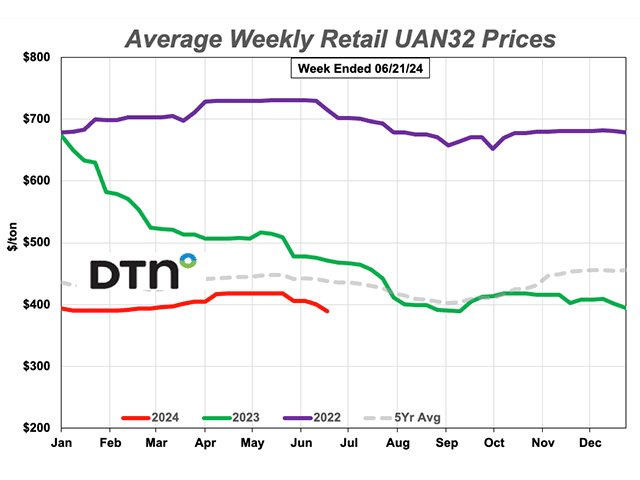
The three fertilizers that saw significant price drops, which DTN designates as anything 5% or more, were anhydrous, urea and UAN32. Anhydrous was 10% less expensive compared to last month with an average price of $705 per ton. Urea was 8% lower than a month ago with an average price of $510/ton. UAN32 was 7% less expensive with an average price of $389/ton.
This is the first time the price of UAN32 has been back below $400 per ton since the second week of March 2024. That week, the average price was $397/ton.
Prices for four other fertilizers were down just slightly from last month. DAP had an average price of $778/ton, MAP $827/ton, potash $507/ton and UAN28 $350/ton.
One fertilizer was unchanged in price from a month earlier. 10-34-0 had an average price of $642/ton.
On a price per pound of nitrogen basis, the average urea price was $0.55/lb.N, anhydrous $0.43/lb.N, UAN28 $0.63/lb.N and UAN32 $0.61/lb.N.
Heavy rains in southeastern South Dakota, southern Minnesota and northern Iowa this past weekend have led to widespread flooding in the region. Missouri River flooding will be an issue this week and beyond, as all this water is expected to push the river out of its banks as it moves downstream.
An issue related to this excess moisture is the question of how much nitrogen fertilizer will be left and available to growing corn plants (https://www.dtnpf.com/agriculture/web/ag/crops/article/2024/06/24/wet-field-conditions-lead-issues).
University of Minnesota Extension nutrient management specialists said recently they believed there would be a good number of fields with some supplemental nitrogen applied, especially in southern Minnesota. And this was before the heavy rains fell over the weekend. More rain could be coming to the region as well.
Farmers should take into consideration many factors before just applying more nitrogen fertilizer, according to University of Minnesota specialists. Among those considerations are the 4Rs: the right rate, the right source, the right placement and the right time.
“In most cases, we only recommend about 30 pounds of additional (nitrogen) when corn follows soybeans and somewhere between 30 to 70 pounds when corn follows corn,” Dan Kaiser, University of Minnesota Extension nutrient management specialist based in St. Paul, said.
All fertilizers are lower compared to one year ago. MAP is 1% lower, DAP is 6% less expensive, anhydrous is 7% lower, both 10-34-0 and UAN28 are 13% less expensive, UAN32 is 17% lower and both urea and potash are 18% less expensive compared to a year prior.
DTN gathers fertilizer price bids from agriculture retailers each week to compile the DTN Fertilizer Index. DTN first began reporting data in November 2008.
In addition to national averages, MyDTN subscribers can access the full DTN Fertilizer Index, which includes state averages, here: https://www.mydtn.com/agriculture/web/ag/markets/fuels-fertilizers#!/fertilizers.
A new product that coats dry fertilizer in a single application is touting an increase in productivity, according to a recent article. You can read about it here: https://www.dtnpf.com/agriculture/web/ag/crops/article/2024/06/19/anhydrous-urea-lead-fertilizer-lower.
| DRY | ||||
| Date Range | DAP | MAP | POTASH | UREA |
| June 19-23 2023 | 825 | 827 | 618 | 619 |
| July 17-21 2023 | 807 | 812 | 608 | 596 |
| Aug 14-18 2023 | 745 | 762 | 558 | 573 |
| Sep 11-15 2023 | 710 | 742 | 500 | 554 |
| Oct 9-13 2023 | 711 | 794 | 506 | 575 |
| Nov 6-10 2023 | 714 | 802 | 509 | 573 |
| Dec 4-8 2023 | 713 | 820 | 516 | 543 |
| Jan 1-5 2024 | 725 | 812 | 513 | 534 |
| Jan 29-Feb 2 2024 | 735 | 809 | 509 | 527 |
| Feb 26-Mar 1 2024 | 756 | 812 | 505 | 536 |
| Mar 25-29 2024 | 779 | 827 | 513 | 576 |
| Apr 22-26 2024 | 781 | 830 | 513 | 585 |
| May 20-24 2024 | 783 | 829 | 509 | 555 |
| Jun 17-21 2024 | 778 | 827 | 507 | 510 |
| LIQUID | ||||
| Date Range | 10-34-0 | ANHYD | UAN28 | UAN32 |
| June 19-23 2023 | 734 | 755 | 402 | 471 |
| July 17-21 2023 | 717 | 713 | 385 | 457 |
| Aug 14-18 2023 | 705 | 630 | 359 | 399 |
| Sep 11-15 2023 | 600 | 696 | 353 | 389 |
| Oct 9-13 2023 | 613 | 804 | 356 | 418 |
| Nov 6-10 2023 | 613 | 830 | 360 | 415 |
| Dec 4-8 2023 | 595 | 847 | 340 | 409 |
| Jan 1-5 2024 | 599 | 789 | 336 | 394 |
| Jan 29-Feb 2 2024 | 610 | 770 | 334 | 390 |
| Feb 26-Mar 1 2024 | 615 | 769 | 341 | 394 |
| Mar 25-29 2024 | 632 | 794 | 360 | 404 |
| Apr 22-26 2024 | 641 | 794 | 364 | 418 |
| May 20-24 2024 | 642 | 781 | 359 | 418 |
| Jun 17-21 2024 | 642 | 705 | 350 | 389 |
Russ Quinn can be reached at Russ.Quinn@dtn.com.
Follow him on social platform X @RussQuinnDTN.