


Looking Back, What Would You Tell Your Younger Self?
DTN Contributing Analyst Philip Shaw looks back at the changes in his life, agriculture and technology since he first started writing his column 38 years ago. He asks what he would tell his 26-year-old self?


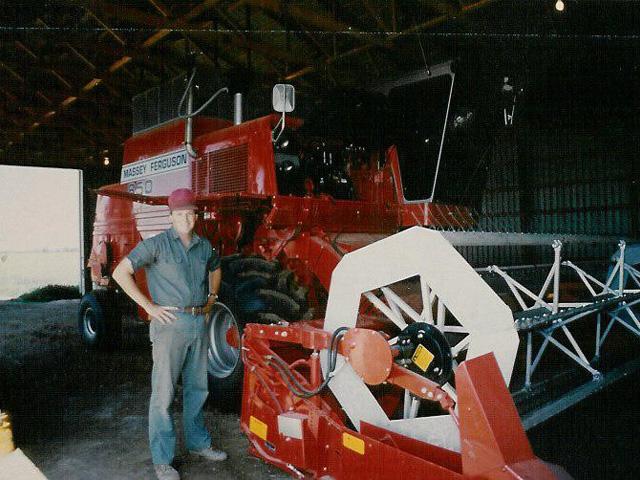
If you had the chance and could go back, what would you tell your 26-year-old self? I don’t really think that is a common lament from me, but I certainly get a kick out of watching other younger authors ask those questions on social media. Typically, the respondents are older people looking back on their lives with changing perspective.
I thought of that this past November when your loyal scribe passed his 38th year of writing this column. Who was that young guy back in 1986 and could I ever imagine still writing this in 2024? If I could, what would I tell my 26-year-old self in retrospect?
It is also hard to say. In 2024, we face many challenges that back in the old days we couldn’t even imagine. In fact, many parts of our economy weren’t even invented back in the 1980s or they weren’t even imagined. Farming was more mechanical versus today where it is a lot more digital. Needless to say, I still think a lever is better than a touch pad, but there is no going back as change is our only constant over all this time.
Back in those early days I wrote mostly about agricultural policy after completing my master’s degree in Agricultural Economics and Business. Over the years, that has morphed into more of a marketing adaptation supported by my professional writing for Ontario commodity groups. As I look back, looking at the different markets from 1986 to today is striking. For instance, back in 1986 our American friends produced 8.266 billion bushels (bb) of corn. This year, according to the latest December World Agricultural Supply and Demand Estimates (WASDE) report, corn is set to come in at 15.143 bb. It’s a huge difference — and also a big difference in reality between now and 1986 when I started writing these pages. Brazil and China were minor agricultural backwaters.
What changed? We know what happened in Brazil and China. However, I suppose the biggest change here has come through the vicious cycle of agricultural productivity fueled through science, genetics and agricultural economics.
I remember very clearly back in the 1980s a good corn crop in southwestern Ontario, if everything came together, yielded 150 bushels per acre (bpa). I remember also in 2007 when my corn average for the first time was over 200 bpa. Nowadays, we’re always very disappointed if we don’t get substantially above that. Not enough rain or too much rain and all the risks inherent in farming are still there. Mitigating those risks continues to be a tremendous challenge, especially when things go south.
I would be remiss to mention that my experience in the 1980s did affect me for the rest of my career and continues to this day. I know that some of you might be tired of hearing it, but I did pay 23.25% interest rates back in the 1980s. Ever since, I’ve been looking over my shoulder and there is no question that experience cost me as time moved on. I tell agricultural students they need to develop the vision of where they want to go and then put together a plan to get there. Unfortunately, for me in the early days, it was digging out from a hostile environment us farmers found ourselves in, which just never ever returned. Being hostage to the past is never a good thing even though lessons can be learned.
A large part of the early days of writing this column had the emphasis on Canadian agriculture policy or lack thereof. It culminated in my mind on April 6, 2006, when I helped lead the largest farm protest in Canadian history on Parliament Hill in Ottawa. The hope was to get a Canadian agricultural safety net which worked.
Regrettably, it never did happen, and it haunts us to this day. However, the ground moved underneath our feet in the days after that with the ethanol revolution and the burgeoning biotech revolution. This was compounded by the ultra-low interest-rate era, which you might argue is still here. Canadian farmers found a way to ride that wave. In 2024, with lots of storm clouds hovering over us, it continues.
Throughout these 38 years, the word subsidy was mentioned many times, especially in the early days as Europeans and the American subsidized their agriculture heavily. That changed to a large extent, but came back in spades as our American friends saw $30 billion of subsidies in response to their own damaging tariffs and COVID. For Canadian farmers, we were simply bystanders knowing that our government wasn’t going to come to the rescue. It’s still the same to this day. Change is our constant, but it also can be nostalgic. What goes around, comes around.
As for me, I’ll continue on. Thirty-eight years ago, I used a pen and paper each week. I drove a tractor without power steering. Let’s just say that some change is good, very good. The world is a far different place now. What would I tell my 26-year-old self? I would ask, “Where do you want to be in 2062?” A tough one for sure. If you took that 26-year-old farm kid from 1986 and dropped him into 2024, he wouldn’t even recognize where he was.
So, as I move on, I’ll just try to keep seeing clearly. Thanks to all my editors and readers throughout all these years.
**
The views expressed are those of the individual author and not necessarily those of DTN, its management or employees.
Philip Shaw can be reached at philip@philipshaw.ca
Follow him on social platform X @Agridome