


Most Fertilizer Prices Continue to Move Lower in First Week of June
Average retail prices for all but one fertilizer were down from last month in the first week of June 2024. For the first time in a month, no fertilizer price moved significantly, which DTN designates as anything 5% or more.



OMAHA (DTN) — Average retail prices for all but one of the eight major fertilizers were lower than last month in the first week of June 2024, according to sellers surveyed by DTN. But for the first time in four weeks, no fertilizer saw a significant price move, which DTN designates as anything 5% or more.
Prices for seven of the eight major fertilizers were down from last month. DAP had an average price of $781 per ton, MAP $827/ton, potash $508/ton, urea $535/ton, anhydrous $757, UAN28 $353/ton and UAN32 $406/ton.
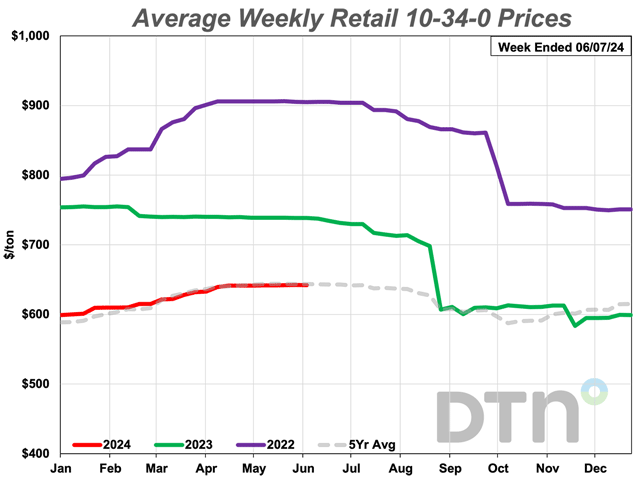
One fertilizer was just slightly higher in price from last month. That was 10-34-0, which had an average price of $642/ton.
On a price per pound of nitrogen basis, the average urea price was at $0.58/lb.N, anhydrous $0.46/lb.N, UAN28 $0.63/lb.N and UAN32 $0.63/lb.N.
With the significant rainfall much of the Corn Belt has received this spring, farmers may be asking themselves if they need to apply supplemental nitrogen fertilizer. In a post from the University of Minnesota Extension Minnesota Crop News titled “Should you apply supplemental nitrogen fertilizer this year?,” author Brad Carlson, Extension educator, takes a closer look at the issue. See that post here: https://blog-crop-news.extension.umn.edu/2024/06/should-you-apply-supplemental-nitrogen.html.
Generally, for most farmers, some nitrogen has been lost. However, it’s probably not enough to warrant an additional application, according to Carlson. Once applied and incorporated, nitrogen is lost through water-based processes. The two loss processes of concern are leaching and denitrification.
“Despite the recent wet weather, we have not drained enough water to significantly move applied fertilizer out of the rooting zone,” Carlson wrote. “It is possible that it has moved down enough that corn may appear yellow until the roots grow to reach it.”
Denitrification is probably more of a concern, according to Carlson. This process becomes much more significant as the soil warms and spring turns to summer.
Saturated soil at 60 degrees Fahrenheit will lose about 6% of the nitrogen present when saturated for four days and 12% if saturated for 10 days. Losses due to denitrification increase to 12% when soil reaches 70 degrees F and are saturated for four days and up to 26% for 10 days.
“Farmers will want to monitor the length of time the soil stays saturated in order to estimate how much nitrogen they have lost,” Carlson wrote. “It should be noted that most locations likely to experience nitrogen loss are also places where the crop was drowned out, making the situation dubious.”
All fertilizers are lower compared to one year ago. MAP is 1% lower, anhydrous is 4% less expensive, DAP is 5% lower, 10-34-0 is 13% lower, both urea and UAN28 are now 14% less expensive, UAN32 is 15% lower and potash is 18% lower compared to a year prior.
DTN gathers fertilizer price bids from agriculture retailers each week to compile the DTN Fertilizer Index. DTN first began reporting data in November 2008.
In addition to national averages, MyDTN subscribers can access the full DTN Fertilizer Index, which includes state averages, here: https://www.mydtn.com/agriculture/web/ag/markets/fuels-fertilizers#!/fertilizers.
Corey Rosenbusch, president and CEO of The Fertilizer Institute (TFI), testified before the House Subcommittee on Energy and Mineral Resources last week in support of phosphate and potash, according to a TFI news release. You can read about it here: https://www.dtnpf.com/agriculture/web/ag/crops/article/2024/06/05/urea-anhydrous-lead-retail-prices.
| DRY | ||||
| Date Range | DAP | MAP | POTASH | UREA |
| May 29-Jun 2 2023 | 824 | 832 | 620 | 622 |
| June 26-30 2023 | 825 | 829 | 620 | 616 |
| July 24-28 2023 | 795 | 791 | 594 | 581 |
| Aug 21-25 2023 | 735 | 764 | 557 | 575 |
| Sep 18-22 2023 | 702 | 757 | 501 | 566 |
| Oct 16-20 2023 | 709 | 791 | 504 | 574 |
| Nov 13-27 2023 | 717 | 811 | 511 | 574 |
| Dec 11-15 2023 | 713 | 819 | 517 | 540 |
| Jan 8-12 2024 | 726 | 807 | 510 | 526 |
| Feb 5-9 2024 | 736 | 809 | 508 | 528 |
| Mar 4-8 2024 | 760 | 816 | 505 | 564 |
| Apr 1-5 2024 | 780 | 828 | 514 | 577 |
| Apr 29-May 3 2024 | 781 | 830 | 513 | 585 |
| May 27-31 2024 | 781 | 828 | 508 | 537 |
| LIQUID | ||||
| Date Range | 10-34-0 | ANHYD | UAN28 | UAN32 |
| May 29-Jun 2 2023 | 739 | 791 | 413 | 478 |
| June 26-30 2023 | 731 | 753 | 396 | 468 |
| July 24-28 2023 | 715 | 691 | 383 | 442 |
| Aug 21-25 2023 | 698 | 622 | 355 | 399 |
| Sep 18-22 2023 | 610 | 763 | 352 | 405 |
| Oct 16-20 2023 | 612 | 809 | 356 | 418 |
| Nov 13-27 2023 | 613 | 843 | 361 | 415 |
| Dec 11-15 2023 | 595 | 851 | 339 | 409 |
| Jan 8-12 2024 | 600 | 776 | 336 | 391 |
| Feb 5-9 2024 | 610 | 773 | 335 | 390 |
| Mar 4-8 2024 | 622 | 788 | 344 | 396 |
| Apr 1-5 2024 | 633 | 794 | 362 | 405 |
| Apr 29-May 3 2024 | 641 | 794 | 364 | 418 |
| May 27-31 2024 | 642 | 758 | 356 | 406 |
Russ Quinn can be reached at Russ.Quinn@dtn.com.
Follow him on social platform X @RussQuinnDTN.