


Most Fertilizers’ Prices Continue Higher, 4 Considerably More Expensive
Prices for six of the eight major fertilizers were higher for the third week of March 2026 compared to a month ago. Four fertilizers were significantly more expensive, which DTN designates as anything 5% or more. One fertilizer was slightly lower, and one was unchanged from the previous month.



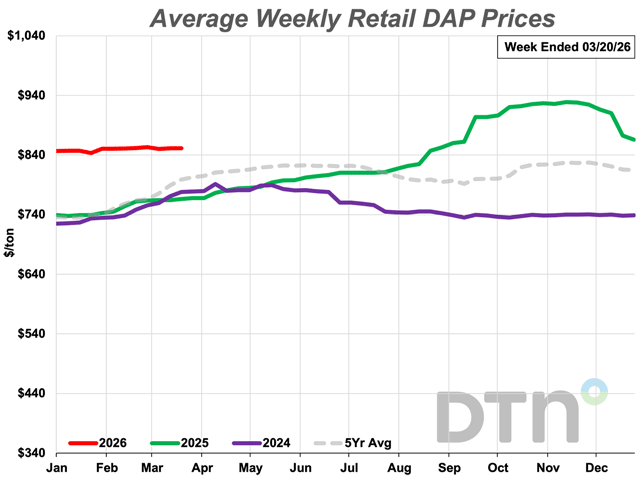
Only one fertilizer was lower priced than a month ago. DAP, slightly lower, had an average price of $851 per ton, but is still 11% higher than a year ago. Meanwhile, UAN28 had the biggest increase, as it jumped 15% higher compared to last month. (DTN graphic)
OMAHA (DTN) — Retail fertilizer prices continued to be mostly higher during the third week of March 2026, according to sellers surveyed by DTN. Nutrients remained elevated with the military conflict continuing between the United States and Iran.
Prices for six of the eight major fertilizers were higher compared to last month, while one was slightly lower and one was unchanged. DTN designates a significant move as anything 5% or more.
UAN28 led the way higher, as the nitrogen fertilizer was 15% higher compared to last month. The liquid nitrogen fertilizer had an average price of $473 per ton.
Urea was 11% higher than a month ago and had an average price of $677/ton. Anhydrous was 8% more expensive compared to last month and had an average price of $931/ton. UAN32 was 5% higher, looking back to the prior month, and had an average price of $489/ton.
Two nutrients were slightly higher in price. MAP had an average price of $886/ton and 10-34-0 $671/ton.
One fertilizer was slightly less expensive compared to last month. DAP had an average price of $851/ton.
One nutrient’s price was unchanged from last month. Potash had an average price of $487/ton.
On a price per pound of nitrogen basis, the average urea price was $0.74/lb.N, anhydrous $0.57/lb.N, UAN28 $0.85/lb.N and UAN32 $0.73/lb.N.
The American Soybean Association (ASA) joined a coalition of agricultural organizations last Friday to send a letter to the U.S. Department of Commerce urging the revocation of countervailing duties (CVDs) on phosphate fertilizer imports from Morocco and Russia, according to an ASA news release.
“We are disappointed Mosaic and Simplot did not listen to their farmer customers and are pursuing an extension of these costly countervailing duties,” said Scott Metzger, ASA president and soybean farmer from Ohio. “Soybean farmers are already facing tight margins and rising input costs, and fertilizer is one of the most critical and expensive inputs we rely on to grow a crop.”
Metzger said trade import duties that limit supply and drive up prices only make it more difficult for producers to remain profitable. Farmers need access to reliable, affordable fertilizer to remain competitive, he said.
The letter warned that maintaining the duties limits access to essential inputs, reduces market competition and places additional strain on farmers navigating volatile markets, rising input costs and ongoing uncertainty. Fertilizer accounted for a significant share of operating expenses in 2025, and elevated prices continue to affect planting decisions and farm viability.
ASA and the coalition called on the Department of Commerce to revoke the duties as part of the current sunset review, noting that doing so would help restore balance
All eight fertilizers are now higher in price compared to one year earlier: 10-34-0 by 3%; potash 7%; MAP 9%; DAP 11%; UAN32 19%; both urea and anhydrous 22%; and UAN28 by 33%.
DTN gathers fertilizer price bids from agriculture retailers each week to compile the DTN Fertilizer Index. DTN first began reporting data in November 2008.
In addition to national averages, MyDTN subscribers can access the full DTN Fertilizer Index, which includes state averages, here: https://www.mydtn.com/agriculture/web/ag/markets/fuels-fertilizers#!/fertilizers.
Iran appears to be allowing some ships through the Strait of Hormuz, freeing a trickle of oil and maybe some nutrients, according to a Dow Jones article. You can read about here: https://www.dtnpf.com/agriculture/web/ag/crops/article/2026/03/18/8-retail-fertilizer-prices-higher-4.
| DRY | ||||
| Date Range | DAP | MAP | POTASH | UREA |
| Mar 17-21 2025 | 766 | 810 | 454 | 556 |
| Apr 14-18 2025 | 781 | 822 | 467 | 577 |
| May 12-16 2025 | 794 | 825 | 469 | 630 |
| June 9-13 2025 | 805 | 832 | 474 | 656 |
| July 7-11 2025 | 810 | 847 | 481 | 658 |
| Aug 4-8 2025 | 822 | 892 | 484 | 646 |
| Sep 1-5 2025 | 860 | 913 | 487 | 632 |
| Sep 29-Oct 3 2025 | 906 | 921 | 483 | 609 |
| Oct 27-31 2025 | 927 | 931 | 487 | 598 |
| Nov 24-28 2025 | 925 | 923 | 489 | 590 |
| Dec 22-26 2025 | 866 | 884 | 484 | 567 |
| Jan 19-23 2026 | 843 | 863 | 482 | 574 |
| Feb 16-20 2026 | 852 | 880 | 487 | 608 |
| Mar 16-20 2026 | 851 | 886 | 487 | 677 |
| LIQUID | ||||
| Date Range | 10-34-0 | ANHYD | UAN28 | UAN32 |
| Mar 17-21 2025 | 649 | 761 | 356 | 412 |
| Apr 14-18 2025 | 656 | 781 | 380 | 448 |
| May 12-16 2025 | 666 | 777 | 412 | 484 |
| June 9-13 2025 | 669 | 773 | 418 | 495 |
| July 7-11 2025 | 672 | 769 | 417 | 501 |
| Aug 4-8 2025 | 669 | 765 | 421 | 498 |
| Sep 1-5 2025 | 667 | 767 | 415 | 481 |
| Sep 29-Oct 3 2025 | 666 | 813 | 419 | 465 |
| Oct 27-31 2025 | 666 | 843 | 412 | 466 |
| Nov 24-28 2025 | 667 | 865 | 417 | 466 |
| Dec 22-26 2025 | 674 | 863 | 409 | 466 |
| Jan 19-23 2026 | 665 | 856 | 409 | 464 |
| Feb 16-20 2026 | 665 | 862 | 412 | 465 |
| Mar 16-20 2026 | 671 | 931 | 473 | 489 |
Russ Quinn can be reached at Russ.Quinn@dtn.com
Follow him on social platform X @RussQuinnDTN
(c) Copyright 2026 DTN, LLC. All rights reserved.