


Retail Fertilizer Prices End 2023 Mixed, With Anhydrous Leading Six Fertilizers Lower
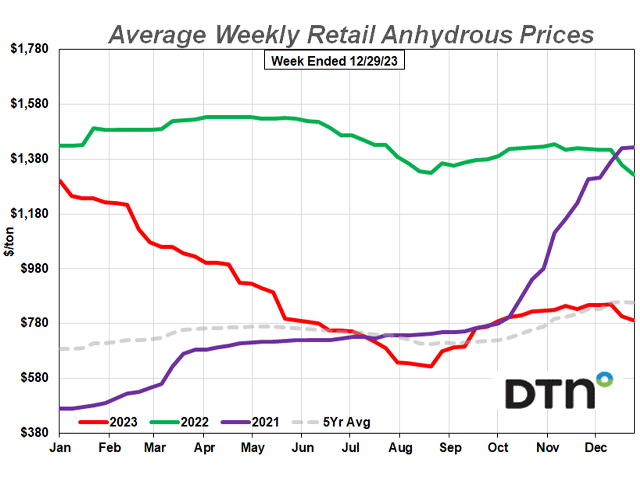
Retail fertilizer prices continued to be mixed at the end of 2023 with prices for six of the eight major fertilizers lower and the other two slightly higher than last month. Only one fertilizer moved significantly: Anhydrous was 7% lower compared to the prior month and had an average price of $792 per ton.



OMAHA (DTN) — Average retail fertilizer prices closed out 2023 mixed, according to sellers surveyed by DTN.
Prices for six of the eight major fertilizers were lower in the fourth week of December compared to last month, while prices for the remaining two fertilizers were slightly higher.
Only one fertilizer had a notable price move, which DTN designates as 5% or more. Anhydrous was down 7% compared to last month with an average price of $792 per ton.
The remaining five fertilizers were down just slightly down. MAP had an average price of $812 per ton, potash $514/ton, urea $536/ton, UAN28 $340/ton and UAN32 $394/ton.
UAN32 dropped below the $400-per-ton level for the first time since the second week of September 2023. That week UAN32 had an average price of $389/ton.
Two fertilizers, meanwhile, were just slightly higher in price compared to last month. DAP had an average price of $721/ton and 10-34-0 $599/ton.
On a price per pound of nitrogen basis, the average urea price was at $0.58/lb.N, anhydrous $0.48/lb.N, UAN28 $0.61/lb.N and UAN32 $0.62/lb.N.
In a year-end article of issues affecting agriculture, University of Arkansas Cooperative Extension Service examined some of the changes in crop prices and input costs seen in 2023 (https://www.uaex.uada.edu/media-resources/news/2023/december/12-15-2023-ark-YEAREND-Commodities-Economy.aspx). Among the subjects covered was the decline in price of fertilizer.
Fertilizer prices fell across North American by about 34% from January to July 2023, according to Hunter Biram, Extension economist for the University of Arkansas System Division of Agriculture.
“This is because it was a relatively warmer year than 2023 compared to 2022, which eased demand pressure on natural gas, a key input in the production of nitrogenous and phosphorous fertilizer,” Biram said.
In the south-central U.S. (Arkansas, Kentucky, Louisiana, Mississippi and Tennessee), urea fell 31% year-on-year, while DAP dropped about 40%. Potash fell 41% during this time.
All fertilizers but one are now lower compared to one year ago: MAP by 9%, DAP 19%, 10-34-0 by 20%, urea 29%, potash 33%, anhydrous 40%, UAN28 41% and UAN32 42%.
DTN gathers fertilizer price bids from agriculture retailers each week to compile the DTN Fertilizer Index. DTN first began reporting data in November 2008.
In addition to national averages, MyDTN subscribers can access the full DTN Fertilizer Index, which includes state averages, here: https://www.mydtn.com/agriculture/web/ag/markets/fuels-fertilizers#!/fertilizers.
The situation with natural gas in Europe is considerably different heading into winter this year compared to last year, according to Dow Jones. You can read about it here: https://www.dtnpf.com/agriculture/web/ag/crops/article/2023/12/27/urea-moves-6-lower-prices-mixed.
If you missed seeing the DTN Global Fertilizer Outlook series in December, you can access it at the following links:
“Global Nitrogen Fertilizer Supply, Demand Outlook Generally Favorable,” https://www.dtnpf.com/agriculture/web/ag/crops/article/2023/12/04/global-nitrogen-fertilizer-supply
“Lower Prices, More Demand Globally Thanks to Increased Phosphorus Fertilizer Supplies,” https://www.dtnpf.com/agriculture/web/ag/crops/article/2023/12/07/lower-prices-demand-globally-thanks
“Positive Potash Outlook Seen With Lower Prices, More Global Demand, Higher Supply,” https://www.dtnpf.com/agriculture/web/ag/crops/article/2023/12/14/positive-potash-outlook-seen-lower
| DRY | ||||
| Date Range | DAP | MAP | POTASH | UREA |
| Dec 26-Dec 30 2022 | 885 | 891 | 765 | 751 |
| Jan 23-Jan 27 2023 | 855 | 865 | 714 | 708 |
| Feb 20-Feb 24 2023 | 836 | 834 | 673 | 666 |
| Mar 20-Mar 24 2023 | 821 | 812 | 645 | 627 |
| Apr 17-21 2023 | 826 | 812 | 643 | 626 |
| May 15-19 2023 | 829 | 831 | 627 | 619 |
| June 12-16 2023 | 823 | 832 | 621 | 624 |
| July 10-14 2023 | 811 | 823 | 614 | 609 |
| Aug 7-Aug 11 2023 | 758 | 764 | 566 | 576 |
| Sep 4-8 2023 | 738 | 745 | 518 | 563 |
| Oct 2-6 2023 | 705 | 791 | 508 | 573 |
| Oct 30-Nov 3 2023 | 713 | 801 | 508 | 573 |
| Nov 27-Dec 1 2023 | 715 | 820 | 518 | 552 |
| Dec 25-29 2023 | 721 | 812 | 514 | 536 |
| LIQUID | ||||
| Date Range | 10-34-0 | ANHYD | UAN28 | UAN32 |
| Dec 26-Dec 30 2022 | 751 | 1325 | 573 | 679 |
| Jan 23-Jan 27 2023 | 754 | 1237 | 523 | 630 |
| Feb 20-Feb 24 2023 | 741 | 1124 | 470 | 554 |
| Mar 20-Mar 24 2023 | 740 | 1036 | 429 | 514 |
| Apr 17-21 2023 | 740 | 995 | 423 | 507 |
| May 15-19 2023 | 739 | 895 | 421 | 514 |
| June 12-16 2023 | 737 | 781 | 406 | 476 |
| July 10-14 2023 | 730 | 734 | 393 | 465 |
| Aug 7-Aug 11 2023 | 714 | 634 | 369 | 400 |
| Sep 4-8 2023 | 611 | 693 | 356 | 390 |
| Oct 2-6 2023 | 609 | 790 | 354 | 414 |
| Oct 30-Nov 3 2023 | 611 | 826 | 358 | 415 |
| Nov 27-Dec 1 2023 | 595 | 847 | 341 | 409 |
| Dec 25-29 2023 | 599 | 792 | 340 | 394 |
Russ Quinn can be reached at russ.quinn@dtn.com
Follow him on X, formerly known as Twitter, @RussQuinnDTN