


DTN Closing Grain Comments
U.S. crop prices were under pressure again Wednesday following a prominent advisory firm unveiling the results of their August yield survey, similar to USDA and others which found corn and soybean yields both above trend. Despite a challenging August for weather in some areas and declining crop conditions in Tuesday's update from USDA, traders are currently seeing very little supply risk as 2025 harvest grows nearer each day. Outside markets on Wednesday were mixed, with equities again on the retreat from last week's highs ahead of what is typically a tough month of September. Meanwhile, energy markets were lower on rumors of another OPEC+ production increase coming in October, which weighed on soybean oil prices which headed to their sixth loss in the past seven sessions.



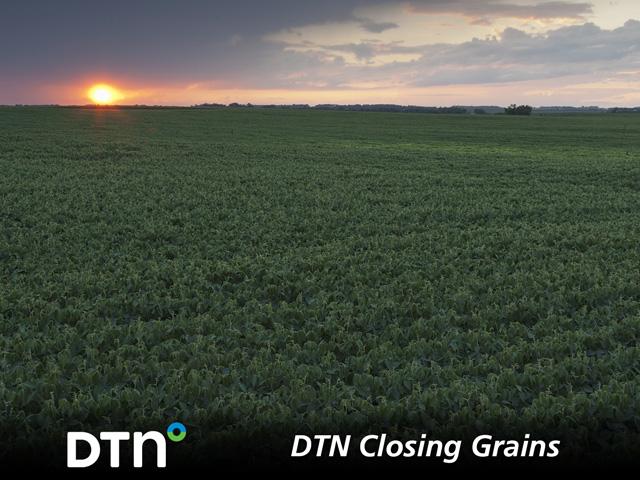
(DTN illustration by Nick Scalise)
DTN Closing Grain Comments
GENERAL COMMENTS:
December corn closed down 5 cents and March corn was down 4 3/4 cents. November soybeans closed down 9 1/2 cents and January soybeans were down 9 1/2 cents. December KC wheat closed down 1 cent, December Chicago wheat was down 6 1/4 cents, December MIAX Minneapolis wheat was down 1 1/4 cents.
The U.S. Dollar Index is down 0.28 at 98.12. The Dow Jones Industrial Average is down 210.0 points at 45,141.0. December gold is up $43.50 at $3,635.70, December silver is up $0.47 at $42.06 and December copper is down $0.0210. October crude oil is down $1.64 at $63.95, October ultra-low sulfur diesel is down $0.0153, October RBOB gasoline is down $0.0321 and October natural gas is up $0.057.
CORN:
December corn futures fell 5 cents Wednesday to $4.18. The corn market was on the defensive following an impressive reversal through trade on Tuesday, with yet another large yield estimate from the private sector weighing on values. The market is appearing to be set up for another test of potential support at the 50-day moving average near $4.14 1/2, which did hold Tuesday. Until the market proves to have a footing at the 50-day moving average and ready to challenge the 100-day, the trend in corn futures is still considered down at this stage.
Tuesday’s crop conditions update from USDA showed national corn ratings fell through the most recent week by 2 points to 69% of the crop now rated good to excellent. Still, this is the second highest to end the month of August over the past decade, which would help explain the market largely ignoring this update through Wednesday’s session. State-by-state results showed declines in Illinois, Indiana, Kentucky, and Ohio — all areas which have been at the heart of dry conditions through August. Western states such as Iowa, Minnesota, and Nebraska remain very highly rated overall, leading many traders to believe potential yield drag in the Eastern Corn Belt may be offset by high production further west.
In ethanol news, the EIA will report on last week’s ethanol production in Thursday’s Petroleum Status report, which is delayed by a day due to Monday’s holiday. Meanwhile, USDA released their Grain Crushings report for July on Tuesday afternoon, finding U.S. plants crushed 455.8 million bushels (mb) of corn for fuel ethanol in July, an increase of 2% from June but down 6% from July of 2024. At this point, corn grind through July has fallen below the pace from a year ago by 0.4%, with USDA only estimating a 0.1% yearly decline. This suggests a further reduction will be necessary in the September WASDE. A seasonal model I have is forecasting the final corn usage for ethanol in 2024-25 to be 5.428 billion bushels (bb) as compared to the USDA August estimate of 5.470 bb.
There are showers scheduled to sweep across the Eastern Corn Belt through the second half of this week, before the 6- to 10-day outlook again turns dry from Iowa east. Rainfall will be important to monitor for finishing the crop, but at this point it may not garner much attention from the day-to-day trade as at this point given the historically high corn acreage even a considerable drop in yield would still result in record corn production for 2025, which is certainly playing a role in trader hesitancy to drive prices higher too quickly.
The DTN National Corn Index finished Tuesday at $3.82. Wednesday’s futures close and implied corn basis of 41 cents under the December board would indicate the index on Wednesday afternoon to be near $3.77.
SOYBEANS:
November soybeans fell another 9 1/2 cents on Wednesday to $10.31 1/2, adding to Tuesday’s selloff to amount to 23 cents of lost value since trade resumed following the Labor Day break. The November contract closed back below the 20-day moving average ($10.33 1/2) for the first time since Aug. 8, appearing bound for a test of major support near the 100-day and 50-day moving averages in the $10.20s.
Tuesday’s Crop Progress report on paper should have been supportive of soybean prices, as ratings declined 4 points over the most recent week to 65% of the crop now rated good to excellent, equal to the August ending rating in 2024. Looking over the past decade, the 65% rating is tied with last year for the fourth or fifth highest August ending rating. It is difficult to draw definitive conclusions based on crop ratings alone, but the weekly declines in Illinois, Kentucky, Indiana, and Ohio again paint a picture that the dry August is potentially taking the top end off yield potential this fall. However, traders at this point are unwilling to translate this into sustained buying on the board given there is an equally large and potentially offsetting question mark on Chinese demand for U.S. soybeans through the balance of 2025 and into 2026.
In other demand news, on Tuesday USDA released their Fats and Oils report for July. USDA found U.S. processors in July crushed 204.74 mb of soybeans, up 4% from June as well as 6% from July 2024. Year-to-date crush for the 2024-25 soybean marketing year through July was 6% ahead of 2023-24, and just a hair below the USDA’s estimated pace. U.S. crush volume totals 2.246 bb through July, meaning that August will need to total 183.5 mb roughly to hit the USDA goal of 2.430 bb.
The DTN National Soybean Index finished Tuesday at $9.65. Wednesday’s futures close and implied soybean basis of 76 cents under the November board would indicate the index on Wednesday afternoon to be near $9.55.
WHEAT:
December Kansas City futures fell another 1 cent on Wednesday to $5.10 1/4. Meanwhile, Chicago and Minneapolis markets were also lower. December KC prices again held just above last Thursday’s contract low of $5.06 3/4 but again fell to the lowest closing price. Most active wheat futures near $5.00 have been a level through the year which has attracted buyers, so it will be interesting to see if that is the case again through the selloff to begin September.
Tuesday’s Crop Progress report marked the conclusion of the 2025 winter wheat harvest, while the spring wheat harvest made steady progress to advance to 72% complete as of the end of August, which is just above the 5-year average pace. Meanwhile, USDA has also concluded ratings for the spring wheat crop for this year given the advanced stage of the harvest.
In world wheat news, the weekly International Grains Council report reflected the strong supplies through this summer’s harvests in the Northern Hemisphere, while also noting that the most recent Australian Ag Ministry forecasts showed considerable improvement to wheat prospects with an estimate of 33.8 million metric tons (mmt), up 3.2 mmt from the previous estimate and 2.8 mmt ahead of the USDA’s estimate in the August WASDE report. This has added an additional layer of pressure to world values as the Argentine and Australian crops both show early promise to backup strong production through the summer and early fall in growing regions such as the U.S., Canada, European Union, and Russia. This leaves traders with very little supply concerns for at least the next six months.
The DTN National HRW Index finished Tuesday at $4.33, while the DTN National HRS Index was at $5.21. Wednesday’s futures closes and implied basis of 79 cents under the December board for HRW, and 54 cents under the December board for HRS, would indicate the indices for Wednesday afternoon to be near $4.32 and $5.20, respectively.
Rhett Montgomery can be reached at Rhett.Montgomery@dtn.com
(c) Copyright 2025 DTN, LLC. All rights reserved.