


Under the Agridome
DTN Contributing Analyst Philip Shaw says the challenge will be managing through a fall where prices, politics and trade winds all feel like they're blowing against Canada.



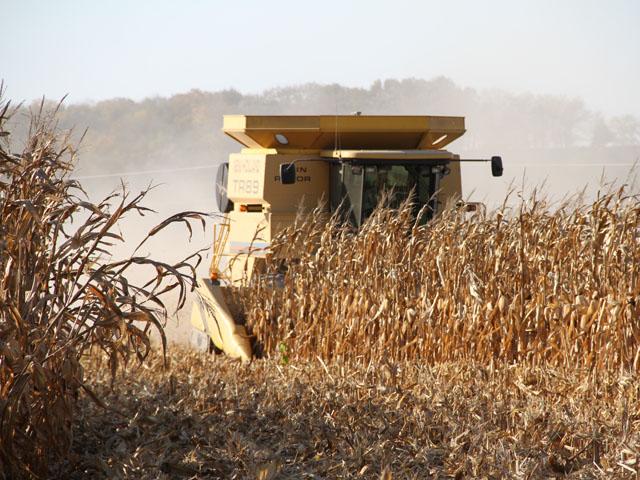
[We won’t know much about the impact of dryness on the crop in the Corn Belt until combines start rolling in a very big way. (DTN file photo by Elaine Shein)]
Under the Agridome
Editor’s Note: Today DTN is sharing content by that is normally reserved for paying customers. Not a subscriber? Check here for a trial: https://www.dtn.com/agriculture/agribusiness/mydtn/
**
During the last few days, I had the opportunity to make my annual sojourn to Tobermory, Ontario. With that, I got to travel to some of the farm country north of me which has suffered quite a bit from drought this past summer. Most of Ontario has received rain lately, which might mitigate some of that, but it’s pretty clear that the crop this year will be sub optimal compared to last year. Who knows, the late dryness in the greater growing season across the North American Corn Belt might even cause some of these heady USDA production numbers to come down in the months to come.
We won’t know much of that until combines start rolling in a very big way. On my farm here in the deep southwest of Ontario, it’s unlikely harvest will arrive until October. Hopefully Jack Frost stays away, and we have a wide-open fall.
Putting markets aside for a minute, I couldn’t help this past week thinking about some of our greater problems that as Canadians we might be facing. Earlier this year, I made it known to almost anybody who reads my work or who came to hear me speak across Ontario that I was expecting harder times to come. It was pretty obvious to me, by the action of the American government, that we as Canadians will face an economy with lower economic growth, fewer choices and much higher prices. It would seem like as the calendar turned into September, the latest economic numbers are backing me up.
Statistics Canada has started to tell some of that story. For instance, we now have an annualized decline at 1.6% in our Canadian GDP in the second quarter of 2025. This was a much sharper drop that many economists had expected and the first contraction in nearly two years since the pandemic. This decline had mainly to do with a 7.5% drop-off in exports, especially in passenger cars and light trucks which were down 24.7%. Industrial machines and equipment were down 18.5%. Yes, it had to do with the second quarter of the economy, even though the annualized basis shows we are slightly positive. However, it was quite a hiccup, and it is mainly coming from the bad Canada-U.S. trade scenario we find ourselves in now.
As you all know, Canada has dropped its reciprocal tariffs that they put on the U.S. earlier after our American friends put punitive tariffs on Canada based on fentanyl and a bunch of other nefarious reasons. The Canadian explanation now is it’s becoming a sticking point in the current negotiations, and it would be better to let that time out. So, as of Sept. 1, those reciprocal tariffs are gone which should help back here in Canada.
On the trade front, things are still at stalemate; it might even become more so as recent U.S. court decisions have muddied the water on the legalities of these earlier tariffs made through executive orders. It could mean that the Canadian government might kick the can down the road into October until the U.S. Supreme Court has its say.
At the same time, everybody has a different opinion and that is especially the case among farmers on different sides of the border. I recently heard a podcast featuring National Pork Producers Council (NPPC) President Duane Stateler talk about the trade challenges of U.S. hog producers.
This is one of the things he said on the podcast referring to U.S. pork products:
“I still feel as though anything that comes out of this country with the USDA stamp of approval on it, bar none, tops anything from anywhere else. We have the best processing, the best science, the best inspections of meats here in the United States compared to anywhere.” He went on to say U.S. corn was better than anywhere else, ditto with soybeans. (Iowa PBS MtoM Podcast, Sept. 2, https://www.iowapbs.org/shows/mtom/mtom-podcast/podcast/13169/pork-industry-seeks-clarity-trade-deals-labor-policy-and).
It was an excellent podcast. The man obviously believed what he said, and it seemed to me he was an excellent advocate for the American position on the pork trade.
However, from a Canadian perspective, it didn’t ring the same way. I have often heard that we have the best processing, the best science, the best inspections, the best corn, the best soybeans and I could go on and on. Ditto for the European Union and who knows where else. The bottom line is everybody has an opinion and in this trading world of agricultural economies the biggest player has the most influence and usually wins. This is what we’re up against as Canadians.
So, the trade tussle continues and if you read the news, you will know Prime Minister Mark Carney is lessening expectations. You might remember when he suggested “elbows up”, while I preferred the basketball term “let’s get back on defence.” I still prefer that hopefully we can play defence into 2026 when our Canadian-United States-Mexico Agreement (CUSMA, or known as USMCA in the U.S.) comes up for renegotiation.
The game is growing long and as we head into harvest — don’t expect it to get easier. The challenge will be to manage through a fall where prices, politics and trade winds all feel like they’re blowing against us. Still, as combines roll and grain fills bins, there will be opportunities. Our job as Canadian farmers will be to stay nimble, keep watching the signals and play the long game until these bigger forces turn.
**
The views expressed are those of the individual author and not necessarily those of DTN, its management or employees.
Philip Shaw can be reached at philip@philipshaw.ca
Follow him on social platform X @Agridome
(c) Copyright 2025 DTN, LLC. All rights reserved.