


Urea Retail Price Down 5%; Anhydrous, DAP Prices Up Significantly
Average retail fertilizer prices continued to be mixed for the second week of October 2025. Prices for four of the eight major fertilizers were up from last month, while prices for the other four were down. Three fertilizers had significant price moves -- two higher and one lower.



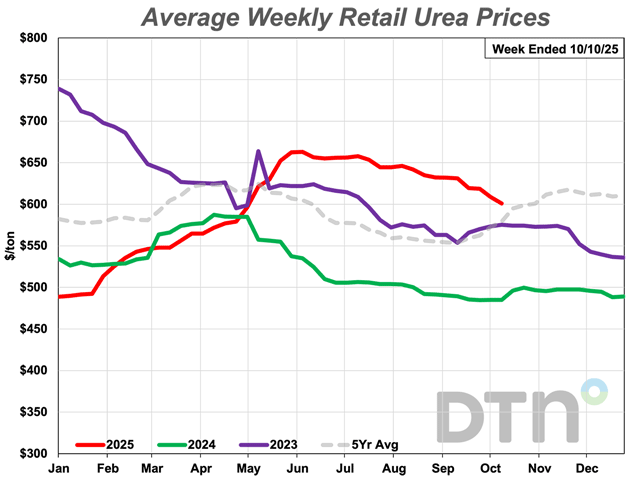
The average retail price of urea during the second week of October 2025 was $601 per ton, down 5% from last month. The price of urea is now 24% higher than it was a year ago. (DTN chart)
OMAHA (DTN) — Three fertilizers saw significant retail price moves in opposite directions during the second week of October 2025, according to sellers surveyed by DTN.
Once again, prices for half of the eight major fertilizers were up from last month and the other half were down. Three fertilizers had sizeable price moves, which DTN designates as anything 5% or more, with two of those moves higher and the third lower.
The two fertilizers with significantly higher prices were DAP and anhydrous. DAP was 7% more expensive compared to last month, with an average price of $921 per ton. Anhydrous was again 6% higher compared to last month, with an average price of $814/ton.
Prices for two other fertilizers were slightly higher. MAP had an average price of $922/ton, and UAN28 was $419/ton.
Urea led the four fertilizers with lower prices than last month. The nitrogen fertilizer was 5% less expensive compared to last month with an average price of $601/ton.
Prices for the three remaining fertilizers were slightly lower than last month. Potash had an average price of $485/ton, 10-34-0 $666/ton and UAN32 $466/ton.
On a price per pound of nitrogen basis, the average urea price was $0.65/lb.N, anhydrous $0.50/lb.N, UAN28 $0.75/lb.N and UAN32 $0.73/lb.N.
In a University of Illinois Extension webinar titled “Management Decisions for 2026,” Extension ag economists discussed the nutrient situation facing farmers in 2026. High fertilizer costs are a major consideration for growers as they prepare their nutrient plans for the next growing season.
One of the most basic ways to make sure nutrients are applied as needed is to conduct a soil test. Gary Schnitkey, University of Illinois professor in farm management, said in most cases, farmers could limit phosphorus (P) and potash (K) applications.
Research shows there is no yield advantage when the Bray soil test for P shows the soil already has high levels of the nutrient, he said.
The same can be said for potash.
“And there is also no yield advantage with soil test levels high at 360 to 400 lbs./acre of potash,” he said.
Nick Paulson, University of Illinois professor in farm management, said there are some application timing practices that can also help crop producers be more efficient.
Fall application of nitrogen provides farmers with some flexibility but also some risk of nitrogen losses. Spring applications, on the other hand, can reduce nutrient losses during the busy fieldwork season, he said.
All eight fertilizers are now higher in price compared to one year earlier.
The last holdout, potash, is now 8% higher. 10-34-0 is 13% more expensive, MAP is 15% higher, anhydrous is 18% more expensive, urea is 24% higher, DAP is 25% more expensive and both UAN28 and UAN32 are 33% higher looking back to last year.
DTN gathers fertilizer price bids from agriculture retailers each week to compile the DTN Fertilizer Index. DTN first began reporting data in November 2008.
In addition to national averages, MyDTN subscribers can access the full DTN Fertilizer Index, which includes state averages, here: https://www.mydtn.com/agriculture/web/ag/markets/fuels-fertilizers#!/fertilizers.
A new carbon tax could raise fertilizer costs in the European Union (EU) for the 2026 growing season. You can read about it here: https://www.dtnpf.com/agriculture/web/ag/crops/article/2025/10/08/anhydrous-dap-lead-retail-fertilizer.
| DRY | ||||
| Date Range | DAP | MAP | POTASH | UREA |
| Oct 7-11 2024 | 735 | 805 | 448 | 485 |
| Nov 4-8 2024 | 739 | 810 | 444 | 496 |
| Dec 2-6 2024 | 739 | 816 | 443 | 496 |
| Dec 30-Jan 3 2025 | 739 | 809 | 444 | 489 |
| Jan 27-31 2025 | 743 | 808 | 436 | 514 |
| Feb 24-28 2025 | 764 | 810 | 446 | 546 |
| Mar 24-28 2025 | 768 | 819 | 462 | 565 |
| Apr 21-25 2025 | 784 | 821 | 468 | 579 |
| May 19-23 2025 | 798 | 827 | 470 | 652 |
| June 16-20 2025 | 807 | 833 | 474 | 655 |
| July 14-18 2025 | 811 | 847 | 481 | 654 |
| Aug 11-15 2025 | 825 | 895 | 484 | 642 |
| Sep 8-12 2025 | 862 | 917 | 488 | 631 |
| Oct 6-10 2025 | 921 | 922 | 485 | 601 |
| LIQUID | ||||
| Date Range | 10-34-0 | ANHYD | UAN28 | UAN32 |
| Oct 7-11 2024 | 590 | 688 | 316 | 350 |
| Nov 4-8 2024 | 607 | 711 | 322 | 364 |
| Dec 2-6 2024 | 611 | 719 | 324 | 363 |
| Dec 30-Jan 3 2025 | 613 | 734 | 324 | 364 |
| Jan 27-31 2025 | 631 | 738 | 325 | 383 |
| Feb 24-28 2025 | 642 | 751 | 350 | 397 |
| Mar 24-28 2025 | 650 | 770 | 360 | 423 |
| Apr 21-25 2025 | 656 | 781 | 381 | 449 |
| May 19-23 2025 | 666 | 779 | 414 | 494 |
| June 16-20 2025 | 669 | 773 | 417 | 495 |
| July 14-18 2025 | 672 | 769 | 417 | 499 |
| Aug 11-15 2025 | 669 | 762 | 421 | 489 |
| Sep 8-12 2025 | 667 | 768 | 414 | 482 |
| Oct 6-10 2025 | 666 | 814 | 419 | 466 |
Russ Quinn can be reached at Russ.Quinn@dtn.com
Follow him on social platform X @RussQuinnDTN
(c) Copyright 2025 DTN, LLC. All rights reserved.