


Gulke: February WASDE Report
The views expressed are those of the individual author and not necessarily those of DTN, its management or employees.



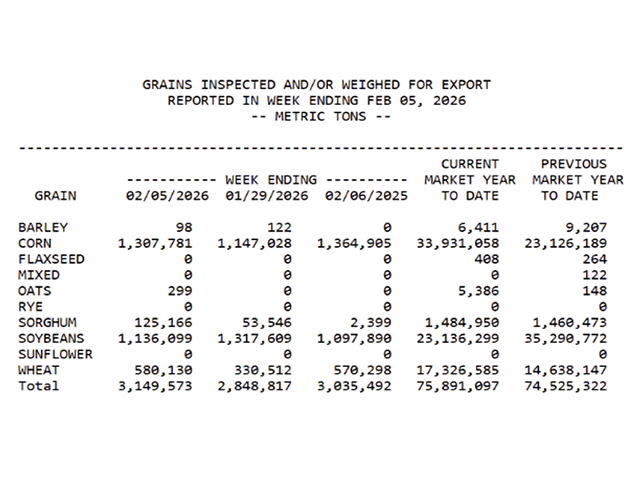
Export sales and grain inspections numbers continue to be supportive week after week. (Chart by Gulke Group)
As expected, Tuesday’s World Agricultural Supply and Demand Estimates (WASDE) report contained no significant trend-changing revisions—with one exception: Corn exports for 2025-26 were raised 100 million bushels (mb), and carryout was lowered by 100 mb. Export increases were anticipated, as export sales and grain inspections numbers continue to be supportive week after week (see the table accompanying this week’s column). For the most part, as mentioned in last week’s column, aside from some tweaking of global numbers, there were no big surprises.
Any implications of further Chinese imports as requested by President Donald Trump were also not reflected, as the WASDE report is data-driven, and USDA will likely wait for confirmation of such action. Waiting for confirmation has also been the focus of most media analysts who are — and have been — data-driven.
We are now basically left with a “realizing market,” one that requires facts upon which to react. However, the price discovery system has lost sight of the principle that futures thinking outside the box should be the norm—something lacking, in my opinion. This leaves the USDA Outlook Forum in a couple of weeks as the next potential market mover.
In the interim, the February price averages are being calculated, but with 10 days already complete, it would require huge moves to push the averages significantly higher or lower. So, it is what it is for planning purposes.
The U.S. and China are planning another meeting in April, if all goes well in the meantime. Thus, any further expansion of the trade agreement framework will come after it is too late to meaningfully change the planted acreage report as of March 31. Those acres are probably pretty well set in stone now. The market seems to be reacting accordingly, as November soybean prices are trying to price in an incentive to expand acreage. July futures are tending to widen their spread with November. And if we happen to see flash sales by China for 2025-26 delivery, that would likely excite traders. It is also interesting that as prices rise, I get texts from buyers saying, “A report is coming; be sure to have your orders to sell in place.” There seems to be a sense of urgency to get orders on the books, yet one couldn’t tell it from the very wide basis for old- and new-crop corn and soybeans in northern Illinois. Perhaps it is the uncertainty we are experiencing.
It may be a coincidence, but on Tuesday, newswires reported that there has been widespread discussion about the validity of USDA’s monthly reports. That concern has gained enough traction that USDA has announced it will conduct an internal review of its process. The following are excerpts from the article published by Reuters:
— “Thousands of employees left the USDA last year as part of President Donald Trump’s drive to shrink the federal government, and experts worry the shrinking staff hobbled the agency’s ability to produce accurate and timely data.”
— “The revisions in January’s report prompted USDA’s National Agricultural Statistics Service, which releases acreage estimates, to launch an internal review, said Lance Honig, a top NASS official.”
— “At the Farm Service Agency, another USDA branch, staffing reductions hampered employees from processing data on plantings last summer and feeding it to the statistics service, said Spiro Stefanou, a former acting USDA deputy undersecretary who resigned last fall. This delayed the statistics service from receiving a complete picture of acreage. ‘NASS had less information to go on,’ Stefanou said. ‘That was going to make their estimates less reliable.'”
— “USDA based June acreage estimates on surveys of nearly 68,000 farmers, who have grown increasingly reluctant to participate. It used the results to estimate harvested acres until surveying farmers again in December and then published the updated results in January, Honig said.”
— “The agency is also exploring options for improving harvested acreage estimates, most likely without more farmer surveys, Honig said.”
— “Honig said it was not clear why USDA’s initial plantings estimate fell short.”
— “In August and September, when USDA mostly increased the plantings estimate, the statistics service incorporated Farm Service Agency data as part of its typical procedures.”
— “In the first half of last year, Farm Service Agency lost about 24% of its employees while the statistics service lost 34% as USDA employees resigned, retired and were terminated, according to government data.”
— “With fewer workers, Farm Service Agency focused on providing money to farmers, its primary function, not on processing and reporting plantings data to be incorporated into acreage estimates, said Stefanou, former administrator of USDA’s Economic Research Service.”
— “Honig said FSA reported and processed plantings data a little slower but that he could not speak to the reason or about staffing in general.”
The upshot: It seems we are in for an interesting season ahead when it comes to timely execution of data out of USDA against a backdrop that will be deemed incomplete by some, especially those caught on the wrong side of the market.
Jerry Gulke can be reached at (707) 365-0601 or by email at Jerry@gulkegroup.com
(c) Copyright 2026 DTN, LLC. All rights reserved.