


Gulke: Is It Time for a Reset?
The views expressed are those of the individual author and not necessarily those of DTN, its management or employees.



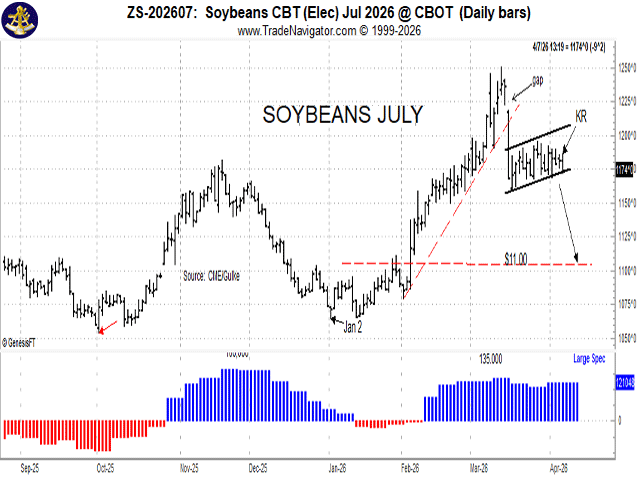
Soybeans paused after a 50% retracement in mid-March and have been forming what serious technical analysts would call a “bear flag.” (Chart by Gulke Group)
The main question I get asked is whether the rallies we have seen since January 2026 are over, and, if so, what is the downside target to expect? Most brokers/analysts will use some kind of previous price posted weeks or months ago to give a wild guess as to what is next. And they will offer advice to either buy a floor under the price with an expensive put option or buy a call option to protect an upside surprise, both of which often expire worthless.
The rally in soybeans since Jan. 2, for example, came as a surprise, as the media had been touting that prices would top out in mid-February like they did last year. This was an example of likely not having a clue but speculating that just because something happened last year, it will repeat. As the chart accompanying this week’s column shows, that did not happen. All the put options purchased were likely worthless four weeks ago, about the time speculation turned more positive and the market ended with a thud, gapping lower and down 70 cents in one day.
To add insult to injury, in mid-February, when media analysts called repeatedly for a top, soybeans were only halfway to where they ultimately topped.
So, what now?
Those who have experience in money flow and price discovery will admit that, often, a market will retrace 50% of a previous rally, as that is what an orderly market will do over time. That is what happened in the 70-cent thumping in mid-March.
Soybeans paused at that 50% setback and have been forming what serious technical analysts would call a “bear flag.” It suggests that after the recent 15 days of trying to claw back some of the losses, either a continuation will occur to trend from the lower left to the upper right (uptrend) or break the trend, suggesting another 60-cent drop to where the 2026 bull market started in earnest back on about Feb. 3 at $11. That resulted in a quick 51-cent explosive trading range, blowing right through $11.
So, for lack of any fundamental news, the bull run lasted about six weeks, attempting to discount most of the friendly news and price appreciation that came as a surprise to the trade. Six weeks is about the typical time frame, give or take, that it takes for a bullish construed market to discount good news and give brokers/analysts enough time to turn from bearish news to seeing the light of day six weeks later. In early January, all we heard about was the big monster crop in Brazil. By the time March 1 rolled around, speculation was less bearish, and maybe China would indeed buy another 8 million metric tons.
Calculators came out and figured what would happen to the price if 8 mmt indeed came about, especially if it happened prior to the harvest next fall of the expected increase in soybean acres. Suddenly, it was realized that stocks would get tight, and November soybeans held their ground while July collapsed. The grain spreaders who bought July and sold November got their heads handed to them rather quickly.
We’ve paused, and now we wait and see. All this time, opportunity presented itself for those who held soybeans on-farm and benefited from those who thought it was folly. Those who wanted to plant soybeans and needed a “12” in front of the price got their wish. Now, we let the market decide!
The large spec net positions are shown at the bottom of the chart (blue and red), showing they are long significantly. The media will tell you they will sell sometime, and when they do, the door won’t be big enough to let them out gracefully. Interestingly, the 70-cent hit did NOT cause a capitulation in the longs; in fact, they stayed long. History shows they can stay long for a long enough time until sellers run out of margin money. This week’s action will go a long way to see if they were sellers or were waiting for the reset.
Jerry Gulke can be reached at (707) 365-0601 or by email at Jerry@gulkegroup.com
(c) Copyright 2026 DTN, LLC. All rights reserved.