


Gulke: Is No News Good News?
The views expressed are those of the individual author and not necessarily those of DTN, its management or employees.



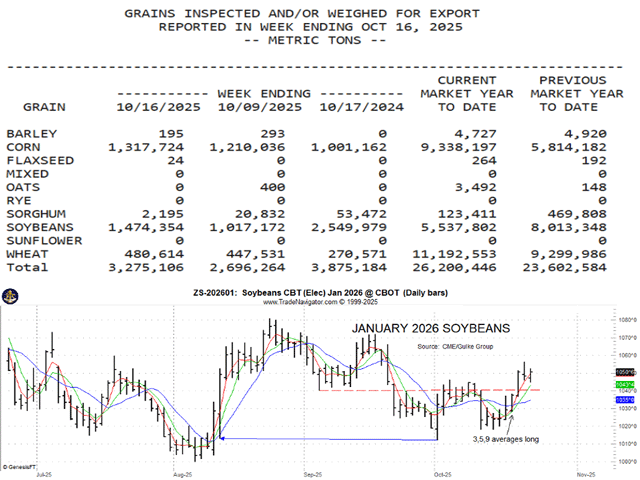
The top chart shows grains inspected for export reported in the week ending Oct. 16. The bottom chart shows January soybean futures market activity. (Charts by Gulke Group)
On first observation, with very little news coming out of USDA due to the government shutdown, one would think analysts are lost without an opinion/analysis, opting to just continue to recommend buying a floor under the markets. Not that buying put options is bad, but timing is important, as is a rational price outlook. If it is a commercial buyer making recommendations, remember it is possession of the physical commodity that is the focus, and once obtained, managing the price risk is what they are supposedly good at.
One of the reports that is still released weekly is the inspections report, which tracks commodity volume actually leaving the U.S. One glance at Tuesday’s report supports why commercial firms focus on obtaining the physical inventory.
I’ve discussed how technical analysis largely predicts in advance what will be fundamentally realized in the future, which justifies my outlook. The inspections report shows that for three weeks in a row, our weekly inspections for corn have outpaced previous year-to-date inspections. Again, corn leads the way, up 60% from last year. Naysayers will suggest this can’t continue, but it does verify USDA’s 2025-26 increased estimate. Looking ahead, the U.S. is still competitive, and the first quarter of a calendar year usually sees increased buying, so we’ll see. Until or unless I see a weekly sell signal, my focus is positive.
Will corn earn the carry reflected in July futures? For now, it may happen like last year, but due diligence is necessary. Interestingly, I mentioned one year ago in September that traders wouldn’t recognize a bull market if they saw one, and the market rallied into Feb. 20, 2025. Concerning is that apparently, the media talking heads read this column, as I’m hearing reflections about last year, possibly a repeat. Once the majority see the obvious, my concerns are that price discovery will suggest the opposite.
Regarding the wringing of hands over the lack of data coming out of USDA, it just points out that most of the news we hear or read about is merely regurgitation of old news. This makes my decades-long methodology of analyzing price movements (price charts) that much more important, and something that will be turned to as a guide by some who otherwise wouldn’t give such a perspective the time of day, let alone mention price movement as a guide. Lack of such expertise is like shooting in the dark. But if the outlook is solely data-driven (from USDA), the data can be blamed for errors. Technical analysis is an art and not a science.
It bears repeating that this column called the early harvest lows months before the market now realizes and now that it is obvious. Further analysis pointed out through the year the highs made in grains/soybeans on Feb. 20, 2025. That was then, and this is now. Discussions in this column regarding managing upside risk using very low-priced call options placed ahead of needs to sell were used to re-own unsold grains that had to be sold off the combine. That strategy has worked well versus paying 37 cents to store beans until Feb. 1 or 25 cents to store corn commercially.
It is nice to see a plan come together. So far, so good. The task now is to determine when our price-discovery system has priced in value of actual and perceived value. I trust the price structure will be ahead of any negative fundamental news. So far, the government shutdown has not had an effect, from my standpoint. An updated soybean chart accompanies this column for your information.
January soybeans tested and validated the low made on Aug. 12 with the release of the August WASDE report, reversed and has exceeded nearly all previous resistance levels and is long my personal indicator (not shown) as well as the 3-5-9 moving averages. Some brokers will use 50-, 100- and 200-day averages as references, but by the time those slow indicators flash positive, the ship has sailed and the risk to act/react is greater, and users become like deer in the headlights, wondering what to do. Note also that indicators turned positive long before Trump had soybeans continually in recent tweets.
For more info on upcoming China trade talks, see video of U.S. Trade Representative Jamieson Greer on CNBC Squawk Box here: www.cnbc.com/video/2025/10/22/u-s-trade-rep-jamieson-greer-chinas-rare-earths-move-was-totally-disproportionate.html.
Jerry Gulke can be reached at (707) 365-0601 or by email at Jerry@gulkegroup.com
(c) Copyright 2025 DTN, LLC. All rights reserved.